
Dream start for the Dreamers? : Evaluating the KJ McDaniels signing.
- Rajat Raghuram

- Jul 28, 2021
- 15 min read
Updated: Dec 1, 2021

( KJ McDaniels showing off his incredible hops during the 2014-15 NBA season,)
Taishin Dreamers 2020 Season Review
The Taishin Dreamers’ inaugural season in the P. League+ was a rollercoaster of emotions. After dropping four of their first five games, it was clear that a lot needed to change in order for them to secure a spot in the playoffs. Many fans attributed their slow start to the fact that the Dreamers were the only team in the league that decided to play small ball. Kyle Julius (head coach of the Taishin Dreamers) had his work cut out for him.
Things started looking up for the Dreamers as they posted a five game winning streak in the middle of the season, thanks in part to the defensive contributions of Jerran Young and Li Dewei. The icing on the cake of the win streak was Chun-Chi Lin winning the MVP of the month award in February. Despite entering into the final stretch of the season with some momentum, the Dreamers’ inability to close out games in the fourth quarter nearly cost them a spot in the playoffs as they won only two of their last eight games. Surprisingly, they managed to cling on to the last playoff spot.
The Dreamers were scheduled to face the Taoyuan Pilots in the first round of the playoffs. The Pilots would have been clear favorites to win the series had it not been for the myriad of injuries that the team was dealing with. The Pilots were entering the series without their star players, Kadeem Jack and Davon Reed and to make matters worse, Quincy Davis would be on a minutes restriction due to his injury issues. The Dreamers were handed a blessing and were expected to cruise through the first round.
The first game went as expected and the Pilots were handed a thirty nine point drubbing. However, the path of least resistance was never discussed in the Dreamers playbook and life became very difficult for Kyle Julius and co after the Pilots stole the next two games. The Dreamers ended up winning the series 3-2 and were scheduled to face the Fubon Braves in the finals. A concerning statistic that required immediate attention was that the Dreamers managed to enter the fourth quarter of every game in the first round leading by double digits and somehow ended up losing nearly each game’s final quarter by double digits. Conversely, the Fubon Braves had no such issues and rarely coughed up leads in the fourth quarter.

(The Dreamers were set to take on the Braves in the P. League+ finals.)
The Dreamers first trip to the P. League+ finals was not an ideal one. Anthony Tucker and Jerran Young both left the team in the middle of the final’s series for personal reasons. Stephen Hicks was now tasked with the responsibility of playing well enough to fill two roster spots. Despite Hicks valiant efforts, the Dreamers eventually ended up losing the COVID-19 shortened finals series in four games.
Offseason Targets
Fresh off of a disappointing finals series, Kyle Julius was looking to make some major changes during the offseason and so far, he has not disappointed. After it was announced that Po-Chih Wang (aka Guardian of the paint: Tank) and Anthony Tucker had signed with the Kaohsiung Steelers, it was clear that there were some big shoes left to fill. The front office got to work and signed sharp-shooter Doug Creighton and highlight-reel KJ McDaniels to one year deals.
(The dynamic duo of the 'Professor' and 'Tank' in action.)
It is likely that KJ McDaniels was brought in to replace Jerran Young considering that they play similar roles. McDaniels is a bona fide star and it would be wise for Kyle Julius acquire the right pieces to build around him during the offseason. In this article I will be discussing the potential impact that McDaniels can have on the Dreamers this season.
KJ McDaniels scouting report

(KJ McDaniels on Draft night.)
KJ McDaniels is best known for his electrifying performances that he delivered during the 2014-15 NBA season while he was playing with the Philadelphia 76ers. The 6 foot 6 wing from Clemson has the deadly combination of a 7 foot wingspan and a quick second jump. It should come as no surprise that he leads the NBA in block percentage amongst players who are 6 foot 6 or shorter. That being said, monster dunks and jaw dropping blocks can only get you on a Sportscenter top ten list. McDaniels will need to outperform some really high expectations in order for this signing to be worthwhile for the Dreamers. At the very least he will need to contribute more than Jerran Young did on both ends of the floor last season.
KJ McDaniels is no stranger to challenging situations. After emerging as a three-star prospect from Central Park Christian High School, he garnered no attention from top tier college programs. He was eventually offered a scholarship to play basketball for Clemson (not a basketball focused college.) McDaniels worked tirelessly to graduate from his bench role to the star of the team and by his junior year, he won the ACC Defensive Player of the Year award. KJ Mc Daniels declared for the draft after his junior year and was picked up early in the second round by the Philadelphia 76ers as a part of Sam Hinkie’s ‘Trust the Process’ strategy.

During this time, the 76ers were notoriously known for hoarding second round draft picks, providing the players with team friendly contracts and eventually trading them away for better assets. The only way out of this deal (for a player) was for them to sign a ‘required tender’ contract that would only provide the league minimum mandated annual salary for a period of one year. Many players shied away from the ‘required tender’ contract as it meant that they would have to enter free agency after their rookie year. However, McDaniels bet on himself and took the riskier option, i.e. the ‘required tender’ contract.
His first season with the 76ers went as well as it could have and many believed that he was going to become a mainstay in the NBA. He finished the season averaging 9.2 points, 1.3 blocks and 3.8 rebounds in 25 minutes of play. Additionally, he was scoring with efficiency as indicated by his true shooting percentage of 49.9%. Throughout the season, KJ McDaniels built up the reputation of being a high flyer and managed to turn each game that he played into a personal dunk contest. Due to the above-mentioned reasons, the 76ers suspected that they could lose out on trade value if they let him test the free agency market and dealt him to the Houston Rockets for Isiah Canaan and a 2015 second-round pick.
At the end of the 2014-15 season, he signed a three-year deal with the Rockets that was worth USD 10 million. Although everything seemed to be looking up for the Alabama native, things did not go as planned from hereon forward. McDaniels looked like a completely different player on the Rockets and it seemed as if he lost the spring in his step. His inconsistent play on the court led to the Rockets frequently assigning him to their D-League affiliate (Rio Grande Valley Vipers.) Eventually he was traded to the Brooklyn Nets in 2017 in exchange for cash considerations. After finishing the 2017 season with the Brooklyn Nets, he did several short stints with a few NBA and G League teams before eventually taking his talents overseas to the Philippines.
It is pertinent to understand the contributing factors behind why he had such a stark drop in productivity. McDaniels was drafted as an athletic wing with elite defensive abilities. The natural progression of his career would have been to transition into a 3 and D player like PJ Tucker or Robert Covington. The Houston Rockets aggressively scouted such players during the Daryl Morey era however, they swung and missed with McDaniels. This was due to the fact that he had a horrible three-point shooting percentage. He has never managed to shoot the three ball above the league average in each year that he played in the NBA and G League. In the absence of a good jump shot, many questioned whether his defense was enough to keep him on an NBA roster. The fact that he is an undersized wing did not do him any favors either.





(McDaniels has spent time with five NBA teams so far.)
Regardless of how things shook out for McDaniels thus far, he was very enthusiastic to make his way back to the NBA. He believed that one of the ways to get there would be to spend some time overseas. Being an import player in a foreign league would allow him to have more of the ball and work on his shortcomings. He spent the 2019 season playing in the Philippines for TNT Ka Tropa.
TNT had enlisted the help of McDaniels in order to win the Governors’ Cup (one of the three conferences in the Philippine Basketball Association.) In the eleven games that he played for TNT, McDaniels stuffed the stat sheet averaging a double-double of 37.1 points and 13.9 rebounds, along with 5.2 assists. Additionally, he was on the court for nearly forty-seven minutes each game. He carried the team on his back and led them to the semi-finals, where they lost against Meralco in gut wrenching fashion. That being said, he had an amazing season and managed to improve upon his three-point shooting and his assist-to-turnover ratio.
KJ McDaniels decided to spend the 2020-21season on the roster of the Greensboro Swarm (Charlotte Hornets G-League affiliate) in order to give him the best shot at a return to the NBA. However, a COVID-19 shortened G League season, coupled with the fact that his usage rate was the lowest it has ever been in his career (18.1%) would delay his dreams of returning to the NBA.
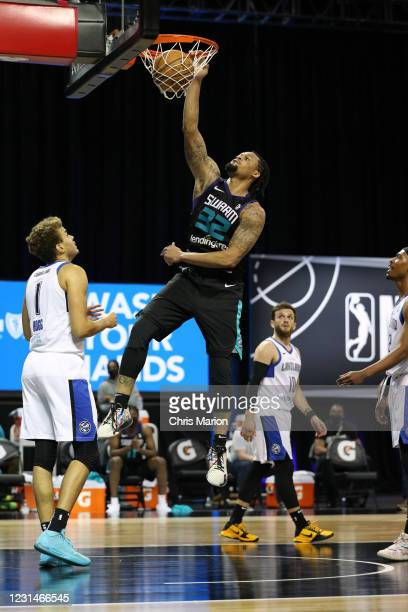
(The 2020-21 season did not end as KJ McDaniels hoped it would .)
McDaniels was forced to make another tough decision. He could either spend another season in the G League, hoping to get picked up by a NBA team in the middle of the season, or take his talents overseas again to sharpen his skills. He chose the latter and signed a one year deal with the Dreamers.
McDaniels strengths lie in the fact he moves well off the ball and attacks the rim fearlessly. He is notoriously known for beating zone defenses with his signature backdoor cut for a would-be easy dunk. That being said, he had to alter his playing style in the Philippines, where playmaking responsibilities would be unevenly shouldered by him. However, that did not seem to hinder McDaniels as he led the league in un-assisted field goals.
It is pertinent to note that the P. League+ does not provide some of the advantageous conditions that are provided in the PBA, which directly led to such an impressive output. For example, the P. League+ does not have height restrictions for their imports, the pace of play is slower and the overall defensive abilities of each team is better than the average PBA team. All of the above-mentioned factors can lead one to assume that McDaniels is probably not going to mimic the level of production that he displayed with TNT. Additionally, he won’t have the liberty of playing only eleven games in a season and will therefore be unable to stay on the court for nearly forty-seven minutes per game. Last season, Anthony Tucker led the league in minutes played per game (42:11 minutes) and as a result only played seventeen games for the Dreamers (of a possible twenty-four games.) On the other hand, Jerran Young managed to play nineteen games for the Dreamers while only averaging 35:54 minutes per game. Although McDaniels playing time can only be conclusively determined after the Dreamers finish signing their imports for the upcoming season, it is likely that he will see slightly more playing time than Jerran Young in the best-case scenario.
I shall now be dividing my analysis into four parts; 1. Offensive needs, 2. Defensive needs, 3. Overall production and 4. Intangibles.
Offensive Needs
Last season, the Dreamers garnered attention for being the only team that decided not to sign an import to play either the power forward or center position. Provided that Kyle Julius decides not to materially change the team’s identity in the 2021-21 season, it is likely that KJ Mc Daniels will have to play in a small ball system. The last time that he was tasked with doing so was in 2016 with the Houston Rockets and we all know how poorly that went. Keeping this in mind, what will be different this time?
The Dreamers are a team that prioritize ball movement. Although it may not seem that way on the stat sheet considering that they have recorded the least number of assists as a team (406), the Dreamers also lead the league in passes made prior to a field goal attempt (1.72.) This implies that the Dreamers biggest problem last season was converting their shots. In order to understand how McDaniels can solve this problem let us take a look at where the Dreamers are primarily taking their shots from.
Nearly 50% of their field goal attempts came from behind the arc last season. Jerran Young, the Dreamers swingman last season, shot nearly 42% of his shots from behind the arc. On the other hand, KJ McDaniels has only ever shot such volume from behind the arc during his 2015-16 assignment with the Rio Grande Valley Vipers. As concerning as that statistic sounds, what is even more worrying is the fact that his three-point attempt rate while playing in the PBA was only 32.96% (the shot charts below tell a similar story) despite being on the court for nearly forty-seven minutes per game. He is not fond of the mid-range jump shot either, having shot less than 14% of his field goals in the range of three to sixteen feet from the basket during his time in the NBA.





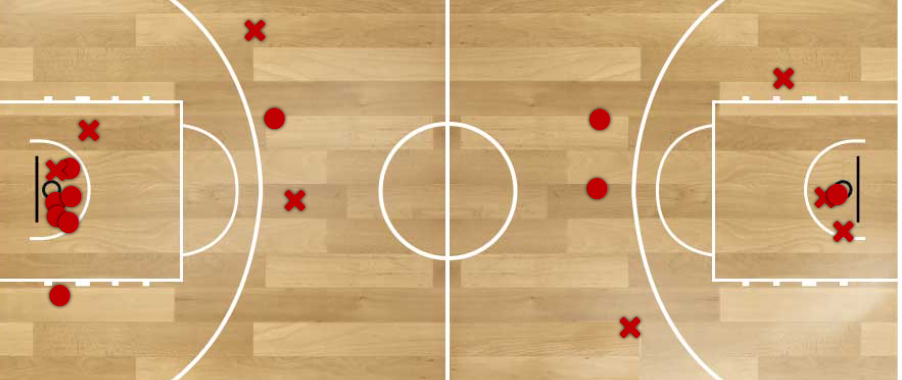


(Shot Charts from KJ McDaniels notable performances in the PBA: 1. 30 points against NorthPort Batang Pier ; 2. 44 points against San Miguel Beermen ; 3. 27 points against Columbian Dyip ; 4. 41 points against Blackwater Bossing ; 5. 51 points against Meralco Bolts.)
The Dreamers run a free-flowing motion offense using the core principles of a pace and space offense. A typical offensive possession for the Dreamers involves variety of flare screens and passes in order to create a drive in-kick out opportunity. This strategy has been successful last season. The Dreamers’ spot up shooters, Randall Walko and Chun-Chi Lin led the league in uncontested three point attempts (uncontested three point attempts implies that the defender was more than six feet away when the shot was taken) as a result of the abovementioned strategy. One of the reasons for the success of the strategy was Anthony Tucker’s ability to stretch the defense and attract double teams.
(This is a typical set play that was frequently run by the Dreamers last season.)
On the other hand, McDaniels has thrived when he gets to play isolation offense. From a skill set perspective McDaniels is simply a superior Brendan Dawson. Both players prefer an isolation offense and attack the rim efficiently. Additionally, McDaniels is benefitted by a 36-inch vertical (for context: Kevin Durant’s vertical is only 33 inches) and the unique ability to utilize a change of pace and stride length while driving to the rim, making his opposing defender look silly in the process.
If the Dreamers decide to allow McDaniels to play isolation offense, it would force them to move away from their pre-existing offensive strategy and possibly adopt a flex offense playbook. They would also benefit by following in the Lioneers’ footsteps and sign an import big man like Hasheem Thabeet. The Thabeet-Dawson combo looked formidable towards the end of the season and seemed like a match made in heaven. Dawson could comfortably drive to the rim knowing that Thabeet would clean up any missed field goals. However, this does not seem to be an offseason target for Kyle Julius as is evidenced by the fact that the Dreamers provided Li Dewei with a contract extension.
Now that we have seen the issues with signing McDaniels, lets take a look at the positives that could possibly arise. Having him on the team will definitely improve the Dreamers’ transition and fast break offense. It should come as no surprise, considering how frequently TNT utilized a run and gun offensive system. Throughout the season, the Dreamers struggled to make the best of their fast break opportunities. McDaniels provides a great combination of pace and physicality. Fans, coaches, player and analysts should expect some entertaining coast-to-coast finishes this season.
Another area in which McDaniels can help the Dreamers out is by providing an efficient offensive output in the fourth quarter. As I had mentioned above, holding leads in the fourth quarter was a real problem area for the Dreamers last season. As the P. League+ only allows one import to be on the court during the fourth quarter, the Dreamers became overly reliant on Tucker or Young to bail them out. This is evident by the fact that the Dreamers only average 1.26 passes per field goal attempt in the fourth quarter (that one pass being a force feed to Tucker or Young.) This framework is ideal for KJ McDaniels as it allows him to run the offense. During his time with TNT, he delivered in the clutch several times. The most notable game was against the Alaska Aces, where he scored eight straight points (including a game tying shot to take his team into overtime) in the fourth quarter and overtime which led them to their seventh straight win. The only person/people who has / have ever bailed out the Dreamers in the fourth quarter, were the referees in Game 1 of the P. League+ finals.
Defensive needs
The Dreamers had a below average season defensively. They finished the season with the third best defensive rating at 105.28. Jerran Young and Li Dewei were the only bright spots on the defensive end of the floor. Young led the league in steals per game (3.32) while Li finished top five in blocks per game (1.09.) Young’s departure from the team will definitely reduce the number of fast break chances that the Dreamers will have this season. That being said, KJ McDaniels was the ideal person to bring in to fix the Dreamers’ defensive woes.
McDaniels was considered a good defender even by NBA standards and never had negative defensive win shares (in a single season) throughout his career. Additionally, he won’t have to make too many adjustments to adapt to the Dreamers defensive schemes. Kyle Julius often makes use of a 2-1-2 or a 3-2 zone defense. McDaniels played in a similar defensive system at Philadelphia and Houston. Lastly, he can provide Li Dewei with some much-needed support. Li shouldered most of the burden of defending the import players on opposing teams. This often led to Li getting into foul trouble early and not being able to help the Dreamers contain centers like Thabeet and Ihor Zaytsev. McDaniels can now share that load and make life easier for Li.
Overall Production
From an overall production standpoint I shall be delving into McDaniels’ player efficiency rating (“PER”), points scored per possession (“PPP”), estimated wins added (“EWA”) and estimated value added (“EVA”.) A holistic view of the abovementioned statistics should give us a general idea about McDaniels potential impact on the Dreamers.
PER is one of the most comprehensive NBA player metrics that exists and provides a decent snapshot of a player’s production. PPP provides an insight into the scoring abilities of a player and rightfully distinguishes between three-point and two-point field goals. EWA and EVA provide the estimated wins and points that a player provides over a replacement player and is an ideal way of determining the value of a new trade or signing.
During the 2020-21 P. League+ season Jerran Young scored 1.03 points per possession. In the same year with the Greensboro Swarm, McDaniels scored 1.05 points per possession. That number was even higher at 1.07 points per possession during his stint with TNT in 2019. Considering that the level of competition is higher in the G league than it is in the P. League+, McDaniels will more than likely beat out Young in the PPP metric.
KJ McDaniels PER was 31.93 (top five in the league) during his stint with TNT in the PBA. Being top five in the league in PER while leading the league in unassisted field goals is no easy feat (PER fails to distinguish between unassisted and assisted field goals.) His last season with the Swarm did see his PER drop to 17.3 however, that should not be much of a concern. On the other hand, Jerran Young’s PER for the 2020-21 season was 22.32. It should also be noted that PER does not holistically measure defensive stats and therefore, overshadows the true value of Jerran Young. Last season, Jerran Young had an EWA of 3.6. This implies that he added 3.6 wins to the Dreamers’ record over what an average replacement player would have. Additionally, he had an EVA of 107.1. The ability to add nearly four wins and one hundred and seven points over a replacement player in a twenty-four game season is nothing short of spectacular.
Even though I have had some choice words to say about the PBA and its talent gap as compared to the P. League+, what KJ McDaniels did in 2019 with TNT was historic. In an eleven game season, he had an EWA of 5.2 and an EVA of 155.6. If he can even come close to that level of production, he will most definitely be in the running for best P. League+ player of all time. If utilized properly, he can give the Dreamers a real shot at winning the second edition of the P. League+. He will most definitely provide a better output than any of the three imports that the Dreamers had last season. At the bare minimum one should expect McDaniels to take home the import of the year award and the scoring title.
Intangibles
Outside of all the numbers and metrics, intangibles are equally important to discuss while evaluating any player. McDaniels is a positive presence on and off the court. He is extremely humble and credits a lot of his success to the continued support provided by his family. It is telling when a player says that the main reason, they want to return to the NBA is to inspire their relatives and the community. Additionally, he spends a good amount of his time undertaking social justice initiatives. While he was in Clemson, he used to provide safe homes to dogs that were abused and neglected.

(KJ McDaniels undertaking social justice initiatives off the court.)
McDaniels does not shy away from leadership roles and has effectively undertaken them during his time in Clemson and at TNT. He will definitely be a positive influence in the locker room. Regardless of how this season shakes out for the Dreamers and McDaniels, entertainment will be guaranteed. P+ League basketball fans are eagerly waiting for the chance to witness the wonders of a McDaniels poster dunk or chase down block. He will be arriving in September, right before the preseason opens. Hopefully, McDaniels’ arrival will inspire the league office to contemplate having a dunk competition in the middle of the season.
On a more serious note, signing McDaniels was one of the best moves that the Dreamers have made since the start of the franchise. However, the Dreamers can only be considered serious contenders if they acquire the right pieces that will allow McDaniels to do what he does best without any encumbrances.


Comments